Data collection
Organize source inputs around the coverage, context, and quality requirements of each AI project.

Data Stack
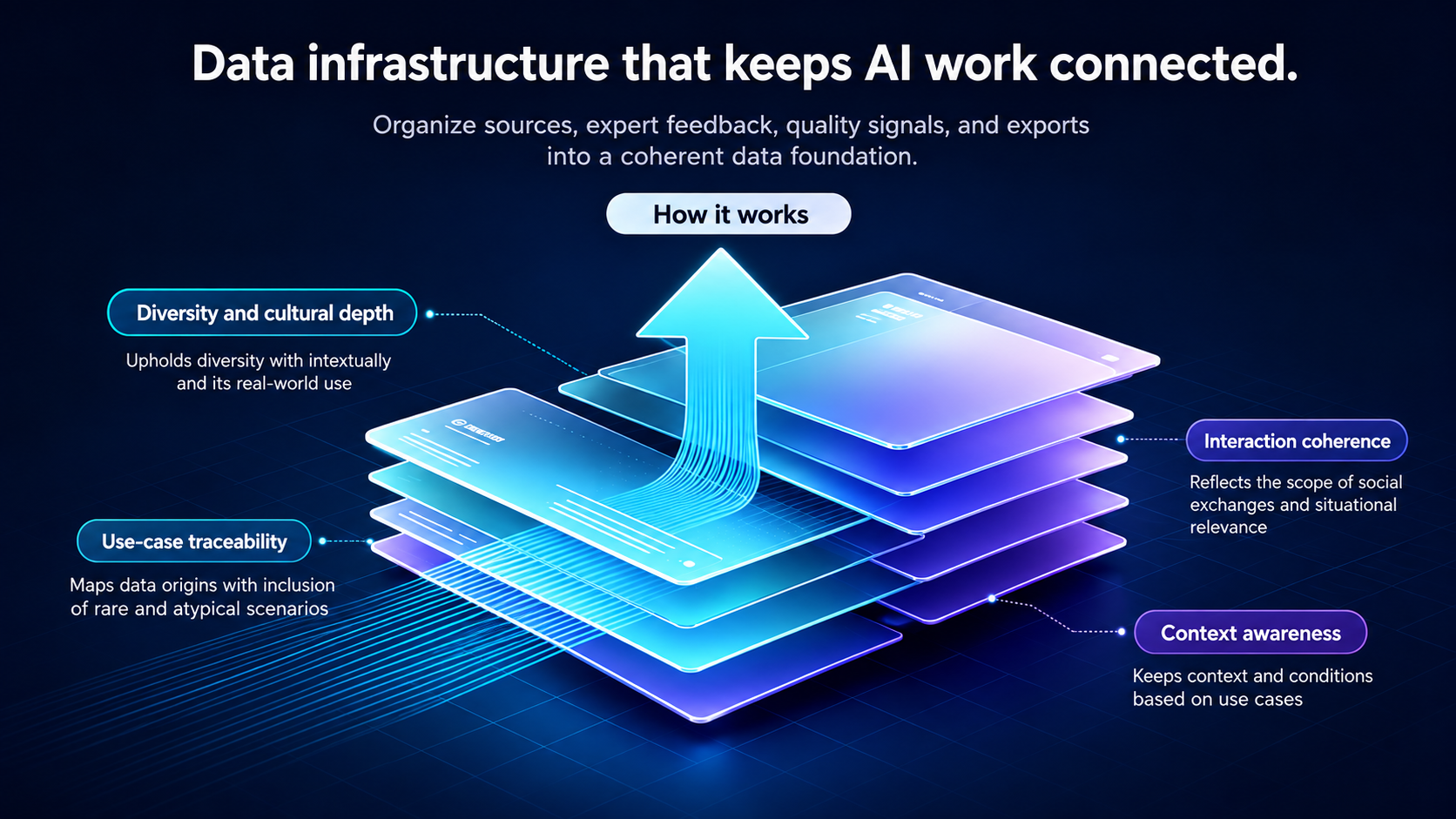
Sinorax AI Data Stack connects collection, labeling, transformation, and quality control to the full lifecycle, data, training, testing, evaluation, validation, optimization, and deployment, so models start with context-rich inputs and stay measurable as they scale.
End-to-end AI enablement
Data Stack is the foundation layer in Sinorax AI's end-to-end enablement model. We prepare context-rich datasets that flow through labeling, ML training, testing, evaluation, validation, optimization, and deployment, so AI systems stay performant, trustworthy, and grounded in reality.
A multi-layer framework for contextual fidelity.
Specialized data precision, from collection to curation
Sinorax AI brings data collection, transformation, curation, training support, testing, and evaluation into one controlled workflow, the data foundation your AI project needs from first capture through final product.
Organize source inputs around the coverage, context, and quality requirements of each AI project.
Refine raw inputs into structured and scalable datasets with defined metadata, labels, and quality checks.
Set project-specific requirements that keep data preparation aligned with the intended model and deployment context.
Prepare datasets for training, fine-tuning, evaluation, and benchmarking within the Sinorax AI workflow.
Sinorax AI's core drivers of contextual data
Review data against defined project criteria to maintain accuracy, relevance, and useful context.
Protect data through controlled collection, transformation, access, and output processes.
Measure dataset quality against the standards and evaluation criteria defined for your AI system.
Frequently Asked Questions
Sinorax AI supports multimodal AI data workflows across images, video, audio, speech, and text. Depending on the project, this can include bounding boxes, polygons, classification, semantic segmentation, keypoints, transcription, text annotation, and other task-specific labeling requirements.
Yes. We can help collect, organize, clean, annotate, and prepare datasets around your specific AI requirements. This may include defining data coverage, identifying edge cases, establishing annotation guidelines, and preparing datasets for model training, testing, or evaluation.
High-quality data helps models learn the correct patterns and reduces the risk of inconsistent labels, missing information, duplicates, and irrelevant samples. Data quality, diversity, coverage, and consistency should be considered together rather than focusing only on dataset size.
There is no universal dataset size that works for every AI project. The required volume depends on the model, use case, complexity of the task, number of classes, environmental conditions, and expected performance. We can help determine an appropriate data strategy based on your project requirements.
Real-world data often contains difficult examples such as occlusion, poor lighting, unusual objects, ambiguous labels, background noise, and rare scenarios. Sinorax AI can incorporate edge cases and project-specific annotation rules into the dataset workflow to improve coverage and consistency.
Yes. An existing dataset can be reviewed, cleaned, restructured, re-annotated, and expanded based on the project's requirements. This can include identifying inconsistent labels, duplicate samples, missing annotations, low-quality data, and coverage gaps.
Yes. We can prepare structured datasets for testing, validation, benchmarking, and performance evaluation. Evaluation data can be designed to represent different environments, scenarios, classes, and edge cases so that model performance can be assessed beyond the training dataset.
A ready-made dataset is useful when your project can work with an existing dataset and requires a faster starting point. A custom dataset is more suitable when your AI system requires specific objects, environments, regions, industries, annotation standards, or real-world scenarios that general datasets do not adequately cover.
We consider the environments, scenarios, demographics, geographic conditions, and other relevant factors that may affect the target AI system. Dataset composition can then be reviewed to identify under-represented scenarios, excessive repetition, and potential coverage gaps.
Data ownership and usage rights are defined according to the applicable project agreement. Sinorax AI treats client data as confidential and does not use client-provided data to train third-party models or share it with external parties without appropriate authorization.
Yes. Sinorax AI can support multiple stages of the AI lifecycle, including data collection, data preparation, annotation, dataset development, model training support, testing, validation, and performance evaluation.
Share your AI use case, available data, target model, or project requirements with us. We can help identify the required data coverage, annotation approach, quality requirements, and workflow before the project is scaled.
Start with the Foundation
Bring us a representative sample of your data or describe the AI system you want to build. We can help define the required data coverage, quality standards, annotation workflow, and evaluation strategy before you scale.
Start a project